Written by: Aisha Ould Habib
The third edition of the Regional Women and Climate Forum kicked off with a special opening, where Ms. Dina Kasbi, Program Manager at the Energy and Climate Project in the Middle East and North Africa at the Friedrich Ebert Foundation, and Ms. Hamza Wadghiri, President of the Climate Action Network in the Arab World, delivered two opening speeches highlighting the objectives of the forum and its importance in providing a platform to discuss the impact of climate change on women in the Arab region.
According to the paper, the opening session of the forum focused on what women in the Arab region are exposed to from a climate perspective, entitled: Women under the influence of climate change“It was held in a dialogue format between the participants in the session to review the current situation and challenges facing women in light of climate change.
The paper added that the opening session was chaired by Mr. Sami Mabrouk, a member of the Board of Directors at Canao, where participants discussed issues related to climate justice and women’s empowerment. The session was attended by representatives from several Arab countries, including Morocco, Jordan, Lebanon, and Iraq. Nisreen Assila presented a legal perspective on women’s participation in climate change efforts, while Ms. Faiza Sleihat stressed the importance of empowering women to meet this challenge. In the same context, Ms. Batoul Mohammed discussed the importance of women’s role in mitigating and adapting to the effects of climate change, and Ms. Mia Farah concluded the discussion by highlighting the international perspective on women’s role in confronting climate challenges.
According to what the experts stated in the first session, there are studies that show that women are affected by climate change by a rate of up to 14 times compared to men in developing countries.This is due to multiple social health reasons. This indicates the need to enhance protection for women and empower them with skills and resources to confront the effects of climate change, in addition to involving them in decision-making.
The main ideas discussed in this session:
Social Justice
Education and Identity
The role of Iraqi women
Second session: “Women and Energy”
Ms. Dina Al-Kasbi chaired the second session, which discussed the role of women in the energy sector and other sectors such as transportation. Dr. Rana Emam participated in the session and spoke about the experience of sustainable transportation in the Middle East and North Africa region, with a focus on social aspects. Ms. Shroff Abdel Ghani shared Jordan’s experience in encouraging the role of women in the renewable energy sector, while Ms. Laila Maalouf spoke about an alternative energy project for a Lebanese hospital, with a focus on empowering women and youth in this process.
A study showed that 47% of Jordanian women reject job opportunities due to the lack of a safe and suitable transportation system. This indicates that women are not only affected by various sectors such as transportation and other influences directly, but also have indirect effects that may affect women’s quality of life and their economic empowerment, and also reflect on the gross national income of a single country.
Main ideas poster for the second session:
- Green transportation
- Jordan's experience in energy transition
- Why don't women use public transportation in the Middle East and North Africa?
Recommendations for the closing of the first day of the forum
Energy:
- The need for financial support to stimulate the use of renewable energy sources and the pursuit of establishing a joint financing fund for the countries of the region.
- Joint cooperation between Arab countries in the field of energy, in the field of infrastructure, financing and exchange of expertise.
- Advocacy and lobbying to integrate renewable energy issues and details into policies and legislation of Arab countries.
- Directing funding to national projects in accordance with transparent policies and regulatory legislation.
- Supporting scientific research and involving universities and research centers in developing projects and establishing regulations and legislation as a key partner.
- Looking at comparative and successful experiences, especially with regard to emission reduction and carbon storage mechanisms.
- Intensifying the study materials and curricula related to climate change and energy at various educational levels, while working to support the practical aspect more than the theoretical aspect.
Urban planning:
- Focus on smart climate applications of all kinds to address climate change in urban areas, taking into account the inclusiveness of women.
- Efficient infrastructure and incentives for the use of environmentally friendly building materials to reduce carbon footprint and increase resilience.
- Pressure on major networks and the imposition of protective conditions linked to fines in the event of their violation.
- Work on inventorying emissions, documenting them, discussing them, proposing appropriate solutions, and emphasizing the continued monitoring of solutions for effective implementation among various stakeholders.
- Integrating climate change principles into all urban plans and strategies and ensuring their adoption by various government agencies, institutions and investors.
- The need to involve civil society in consultative sessions for new facilities and new developments.
The second day of the regional forum
The second day included several dialogue and presentation sessions that discussed the role and relationship of women to climate issues. They also discussed agriculture and the health sector, and highlighted successful Arab regional experiences to benefit from their experiences.
Session 3: Women in the agricultural and health sectors
The first dialogue session was moderated by Mr. Mahdi Kayed, a member of the administrative body in Kanao, and addressed the topics of agriculture and health and how women are affected by each. Participant Israa Adwan spoke about the impact of agriculture on Palestinian women and how her organization “Oxfam” worked to create an agricultural insurance system to avoid some of the risks that women in Palestine face in the field of agriculture. While Wafaa Kharfia spoke about the challenges facing Tunisian female farmers between the absence of fair law and the challenges of climate change. Intersecting with Covid-19 and its effects, Menatallah Saleh spoke about the situation of Egyptian female farmers, specifically in the Kafr El-Sheikh region in light of climate challenges and the negative effects of Covid-19. Moving on to the topic of health, Iman Abdel Azim spoke about the health hygiene of urban women in light of climate change.
According to what was mentioned in this session, food security in Palestine is weak, and last year food insecurity in the Gaza Strip reached 60%.
The most important points mentioned in the posters of the main ideas discussed in this session:
- Palestinian women.
- Tunisian woman.
- Women and health.
- Social justice.
Session 4: Regional Success Stories
In the fourth session, participants reviewed regional stories that succeeded in positively impacting women in light of climate change, and part of them dealt with success stories led by women.
Starting from the Iraqi success story in Mosul presented by Mr. Tariq Al-Taie, to the success of a Jordanian institution that worked to include gender inclusion in its projects on climate change, presented by Ms. Rawan Al-Sabah, and ending with Ms. Dhikra Al-Gharbi and Jihan Al-Ghadhban’s presentation of a Tunisian success story, in which the women of the EcoPact Foundation contributed to the success of projects that contribute to climate action in Tunisia.
Climate action in Iraq has recently had a significant impact on all segments of society, not just women, as Iraq is in a post-war recovery phase.
- Mosul city
- Jordanian women
- Green Tunisia
Session Five: Women in the Framework of Peace
The fifth session was moderated by Ms. Hanin Shaheen, a member of the administrative body in Kanao, who discussed during the session how women are affected in political conflicts in light of climate change, and proposed solutions on how to mitigate this impact and empower women to overcome these challenges together.
Participant Ahmed Yassin spoke about the status of Palestinian women, the nature of the challenges they face under the umbrella of the occupation and its political conflicts that have been ongoing for decades, and how climate change contributes to increasing and magnifying this negative impact on Palestinian women, while participant Maria Geagea spoke about a similar context for Lebanese women, and added about the social impact on women in light of climate change and political conflicts. While Kholoud Baghouri discussed how sustainable development contributes to overcoming part of the climate crisis and the crisis of political conflicts in order to achieve peace.
- Lebanese woman
- equitable distribution of resources
- Climate change effects
Recommendations for the conclusion of the second day
Financing:
- Calling for fair distribution of funding among countries and reducing and facilitating funding requirements from international donors.
- Recommending transparency in procedures for obtaining funding and establishing international accountability mechanisms for industrialized countries for their role in the rate of emissions and their impact.
- Recommend transparency in procedures for obtaining funding.
- Establishing international accountability mechanisms for industrialized countries for their role in the rate of emissions and their impact.
- Recommending diversification of funding sources between local and international financing funds and banks.
- Involving local community representatives in determining work priorities and various projects.
- Allocating part of the budget of donor countries and affected countries to confront climate change.
- Recommending support for banks in affected countries and raising their efficiency so that they are able to receive and spend funds.
- Working on presenting joint Arab projects on various topics and benefiting from regional expertise.
Conference of the Parties COP
- Activating the loss and damage fund, clarifying its working mechanisms, and providing it with funds.
- Seeking to accelerate the pace of work for energy transformation in the region.
- Calling for regional/Arab networking between institutions in the field of recommendation to enhance the participation of Arab delegations in negotiations, especially civil society, youth, university students and academics, and for there to be effective participation of women within the official delegations of Arab countries and for them to be at the negotiating table and make decisions through training and awareness programmes and the transfer of expertise.
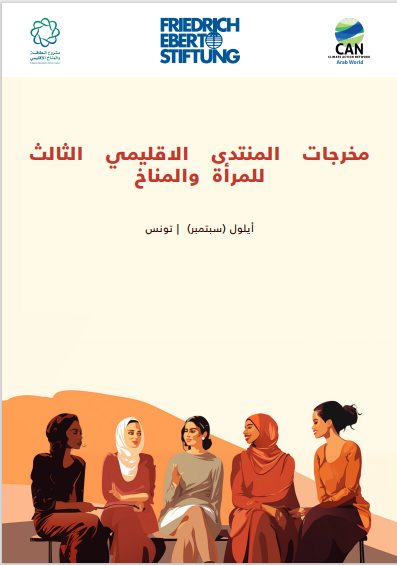
The output paper of the Third Regional Forum on Women and Climate can be viewed and referred to via this link: