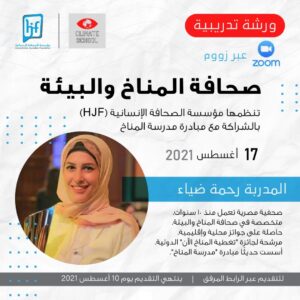
We share with you the most prominent resources included in the training course organized by the Climate School Initiative on March 20 and 21 under the title “The Roles Women Play in Confronting Climate Change,” with a grant from the International Journalists Network’s Emerging Media Initiatives Mentoring Center Program, which benefited 25 journalists, both male and female, from Egypt, Tunisia, Jordan, Sudan, Yemen, Lebanon, Syria, Iraq, Morocco, Libya, Algeria, Mauritania, and Palestine.
The course was led by trainers Rahma Diaa and Hadeer El-Hadary, who explained the reasons for women’s vulnerability to climate change and the evidence and proof of this. They then discussed the inevitability of putting women at the heart of press coverage and the importance of highlighting the roles women play in confronting climate change and how educating, empowering and involving women in decision-making and policies related to climate change can make a big difference.
Here are a few resources that can help you in your journalistic work:
–paper Titled “Gender: The Missing Dimension in Climate Change Responses,” published on the Alternative Policy Solutions project website, it includes the diverse impacts of climate change on women, supported by evidence and figures, including health impacts, impacts on livelihoods, deaths from natural disasters, and gender-based violence.
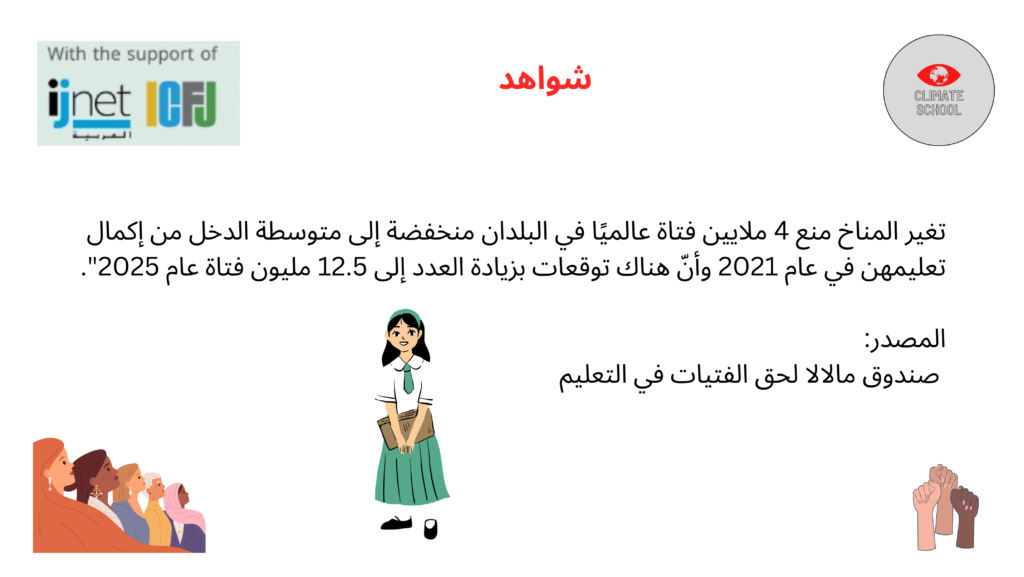
–a report Malala Fund published a report on girls’ education entitled “Why Leaders Should Invest in Girls’ Education” which includes a wealth of statistics on girls’ dropout rates and their exposure to early and forced marriage, which limits their educational opportunities. We know from the report, for example, that:
Climate change prevented 4 million girls globally in low- and middle-income countries from completing their education in 2021, and the number is expected to increase to 12.5 million girls in 2025.
– a report “Feminist Climate Justice - UN Women - December 2023” Important information included in the report:
By 2050, climate change could push up to 158 million women and girls into poverty, and an additional 236 million women will experience food insecurity.
– Climate change is exacerbating crises around the world, from economic inequality to geopolitical gridlock, and has disproportionate impacts on women and girls.
-As indicated Estimates The United Nations Environment Programme estimates that 80 percent of people displaced by climate change are women.
Displaced women in tents and emergency shelters are at double risk of sexual violence, according to word UN High Commissioner for Human Rights Michelle Bachelet, at the 50th session of the Human Rights Council.
The United Nations Special Rapporteur on Violence against Women, Reem Al Salem, monitored in a report Submitted to the UN General Assembly in October 2022, evidence indicates that forms of physical violence against women and girls are exacerbated by the negative impacts of climate change, including trafficking, sexual exploitation, early and child marriage and school dropout.
The world loses $2.4 trillion annually due to unclean cooking fuels, more than half of which ($1.4 trillion annually) is related to health impacts, and $0.8 trillion in lost productivity from women, according to To report World Bank on access to cooking fuel services in 2020.
Only -0.01% of global funding supports projects that address climate and women's rights according to a report To the United Nations - March 2024.
–a report UN Women monitors a set of statistics on the effects of climate change on women in health, agriculture, household chores, domestic violence, and other information contained in the report:
-Women in sub-Saharan Africa collectively spend about 40 billion hours a year collecting water. In a week, women in Guinea spend 5.7 hours collecting water, compared to 2.3 hours for men; in Sierra Leone, women spend 7.3 hours collecting water, compared to 4.5 hours for men; and in Malawi, the figure is 9.1 for women, compared to 1.1 hours for men. This has a significant impact on women’s employment opportunities.
– a report World Meteorological Organization March 19, 2024 and its most prominent results:
The State of the Global Climate report confirms that 2023 is the hottest year since records began by a clear margin.
Records have been broken for ocean heat, sea level rise, Antarctic sea ice loss, and shrinking glacier extent.
Extreme weather events undermine social and economic development.
-The shift to renewable energy offers hope.
The cost of climate inaction is higher than the cost of climate action.
– a report UNICEF monitors women and girls’ views on climate change and the need for their participation in climate action. It reported that:
-Girls' voices are underrepresented in climate discussions, leading to policies that address their specific needs.
The survey included 33,523 girls from 90 countries.
- Nearly 3 in 10 girls are not aware of climate change, and 1 in 10 have never heard of it.
-FAO report on how women face marginalization in the field of climate change and according to For the report:
-The percentage of women working in agricultural and food systems is 36 percent of the total number of women working worldwide, compared to 38 percent of men.
-Women's working conditions are unfair, with work being irregular, part-time or low-skilled.
-Women working for wages in agriculture earn 82 US cents for every (1) US dollar earned by men.
Women have fewer land rights, have less access to credit and training, and must work with technology designed specifically for men.
– Inequalities result in a 24 percent productivity gap between male and female farmers working on farms of equal size.
-found a report The United Nations says countries with more women in parliament and involved in local natural resource management often see more stringent national climate change policies adopted, leading to lower emissions.
If a woman plays Role Matching the role men play in labor markets, it is possible to add up to $28 trillion, or 26%, to global annual GDP by 2025.
-It will bridge the climate finance gap needed to finance the fight against climate change, which amounts to 810 billion euros by 2030.
–a report Prepared by the Food and Agriculture Organization (FAO), it states that treating women equally in agricultural and food systems would boost the global economy by US$1 trillion and reduce food insecurity by 45 million people.
–a report Issued by the African Women and Climate Change Adaptation Initiative, it includes a set of figures and practices to achieve gender equality, with a focus on the agricultural sector and the percentage of women working in it at the global level.